Where Regionals Reclaim Their Edge & Time
A regional manager’s role is high-stakes, high-speed, and central to the multifamily system. We help regionals create clarity, rebuild capacity, and navigate complexity with precision.
State of the Industry
Multifamily operations can be chaotic, and the expectation that leaders create order out of that chaos has never been higher. But many believe these challenges can be solved with more leadership training alone. Those who have lived in the regional role know the issues run deeper. The structural problems rooted in the design of the role, the volume of competing demands, and the idiosyncratic nature of each portfolio forms a system that absorbs bandwidth faster than leaders can regain it.
When the industry grew by two million units, it required more than 8,000 new property managers, 1,600 regionals, and 500 directors to step up quickly, many into an unprecedented market cycle. Expediting promotions at this scale isn’t a simple problem; it’s a seismic shift in the support structure that once existed.
Combine the design flaws of the role with today’s pressures, new supply, rising costs, and compressed timelines, and even the most experienced regionals are challenged by the pace and expectations of the environment.
Where the System Converges
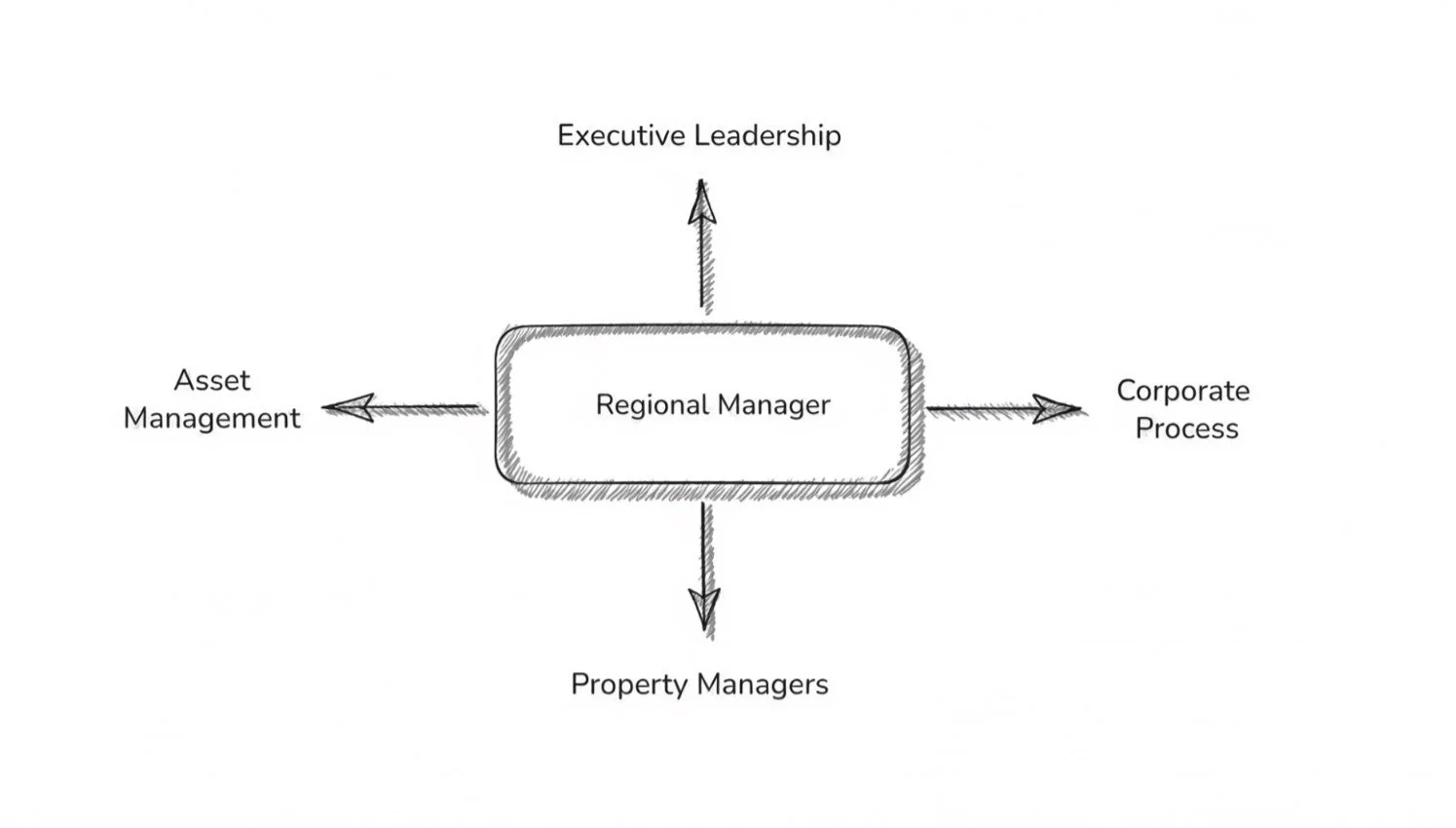
As the core role in the system it supports, regional managers influence three key areas of a portfolio: people, performance, and productivity. Their days are spent bridging the gaps between asset management expectations, property management realities, and corporate systems and processes.
Regionals are often promoted for excelling at leading a property, but the shift from site operations to portfolio leadership is not a linear step. This transformational change cannot be taught through instruction alone and is frequently left to individual trial and error. This results in a constant drain on their time and decisions, keeping many in a hard to break, reactive cycle.
Reengineer Your Role
What if there was a way to rechart a path out of what feels like inescapable chaos? By designing a sustainable system that breaks traditional path dependencies, regionals can restore time, preserve work, and bring clarity to those outside of it. If an invitation to reengineer your role in just a few days landed in front of you, would you take it?